A nurse logs into a shared workstation 70 times per shift. An ED physician toggles between an EHR, a PACS viewer, a medication reconciliation tool, and a scheduling platform, each demanding its own credentials. Meanwhile, the health system has invested seven figures in clinical AI to shave minutes off radiology turnaround.
The math rarely works. Healthcare workflow automation delivers measurable outcomes only when every layer of the stack, from identity verification to AI-assisted charting, operates as one continuous process. Most current guides cover the clinical and administrative layer thoroughly: ambient scribes, stroke triage, automated reminders, claim processing. Few address the foundation underneath: who is authenticated, on which device, with what level of assurance, and how that authentication itself becomes automated.
This guide treats automation as a full-stack discipline. The clinician's time, the patient's safety, and the CIO's risk posture depend on it.
What Is Healthcare Workflow Automation and Why It Matters in 2026
Healthcare workflow automation uses software, rules engines, and machine learning to execute repetitive clinical, administrative, and security tasks without manual intervention. In 2026, 83% of US health systems report active automation programs, driven by clinician shortages and tightening HIPAA enforcement.
Defining Clinical, Administrative, and Identity Workflows
Clinical workflows cover triage, charting, imaging review, and order entry. Administrative workflows handle scheduling, billing, claim submission, and patient reminders. Identity workflows, often overlooked, govern provisioning, authentication, session continuity, and deprovisioning across EHR, PACS, and RIS. A single hospitalist may traverse all three layers thirty times per shift.
Workflow Automation vs. RPA vs. AI: Understanding the Distinctions
RPA scripts mimic human clicks on legacy interfaces. AI infers outcomes from unstructured data, such as ambient scribes converting speech to structured notes. Workflow automation orchestrates both, plus identity and access controls, into a coherent process spanning the clinician, the device, and the organization.
The Hidden Layer Competitors Miss: Identity as the Foundation of Every Automated Workflow
Why a Compromised Credential Nullifies Every Other Automation ROI
Every automation vendor publishes time-saving figures for AI scribes, radiology triage, and appointment scheduling. None of those gains survive a stolen password. When an attacker authenticates as a clinician, the AI tool dutifully drafts notes under their identity, the EHR opens charts, and audit trails record legitimate-looking activity. According to HHS OCR breach data, credential compromise drives the majority of healthcare incidents, and each one freezes the very workflows automation was meant to accelerate.
The Layered Stack Model: Identity, Access, Clinical Logic, Data
Picture the automated workflow as four stacked layers: verified identity, contextual access policy, clinical logic (AI, RPA, orchestration), and patient data. Remove the bottom layer and the stack collapses. FIDO2 authentication anchors that base by binding every automated action to a phishing-resistant credential before any clinical tool executes a single task.

High-Impact Clinical Workflow Automation Use Cases
AI Scribes, Ambient Documentation, and EHR Integration
Ambient AI scribes capture the clinician-patient conversation and draft structured notes directly into the EHR, cutting documentation time by up to 70% in published deployments. The automation only holds if the provider signing the note is verified through strong authentication, otherwise the audit trail breaks and billing claims become contestable.
Radiology Triage, ED Throughput, and Patient Communication
Radiology AI prioritizes worklists by suspected pathology, while ED platforms orchestrate triage, bed assignment, and automated patient communication such as appointment reminders. Each task chains a clinician identity to a clinical action, a PACS query, or an outbound message. Without single sign-on across RIS, PACS, and the EHR, every handoff reintroduces manual login friction, eroding the throughput gains the technology promised to deliver.
Tap-and-Go Authentication: The 15–45 Minute Per Shift Opportunity
The Login Tax on Shared Workstations, COWs, and Kiosks
A nurse on a 12-hour shift authenticates 70 to 150 times across COWs, medication carts, and ward kiosks. At 15 to 30 seconds per password-based login, the cumulative cost reaches 15 to 45 minutes per clinician per shift. Multiplied across a 400-bed hospital, this hidden tax consumes thousands of clinical hours annually, directly competing with charting, patient communication, and bedside care.
How FIDO2, Smart Cards, and Proximity Authentication Work
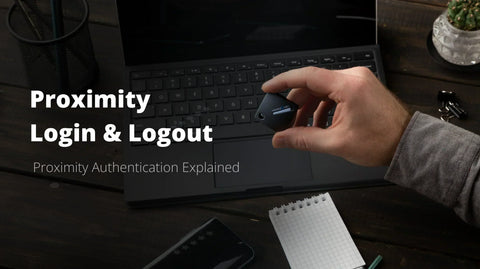
Tap-and-go authentication replaces typed credentials with a physical gesture. A clinician taps a FIDO2 security key, smart card, or BLE token against a reader; the workstation verifies the cryptographic challenge against the identity provider and unlocks the session in under two seconds. Proximity-based protocols extend this to automatic lock-on-walk-away, satisfying HIPAA access controls without manual logout. The result: phishing-resistant authentication that behaves as workflow automation in its own right.
Automating HIPAA Compliance: From Manual Burden to Continuous Guarantee
HIPAA compliance fails when it depends on spreadsheets and quarterly reviews. Automation converts the Security Rule's access requirements into a continuous, auditable state managed by the Hideez identity platform itself.
Automated Provisioning, Deprovisioning, and Role-Based Access
When a nurse joins a unit, the HR system triggers provisioning across the EHR, PACS, and clinical messaging apps based on role attributes. Departure or rotation revokes access within minutes, closing the orphaned-account gap that auditors consistently flag. Role-based policies map directly to the minimum-necessary standard, removing manual ticketing from the equation.
Audit Trails and Credential Lifecycle Management
Every authentication event, privilege change, and session termination writes to an immutable log tied to a verified clinician identity. Credential lifecycle management, issuance, rotation, revocation of FIDO2 keys, is enforced by policy, not memory. When OCR requests evidence, your HIPAA audit trail is already assembled.
The Cybersecurity Blind Spot: Why Phishing and Ransomware Are Workflow Problems
Ransomware Downtime as the Ultimate Workflow Failure
When Change Healthcare went dark in February 2024, claims processing froze across the industry for weeks. No AI scribe, no radiology triage tool, no scheduling platform delivers ROI when clinicians revert to paper. Downtime is the workflow failure that erases every other automation gain, and credential theft remains the entry point for the majority of healthcare ransomware incidents tracked by HHS OCR.
Phishing-Resistant Authentication as Workflow Insurance
Passwords and OTP-based MFA fail against modern phishing kits. Phishing-resistant authentication built on FIDO2 cryptographic challenge-response cannot be replayed, intercepted, or social-engineered out of a clinician. Treat it as insurance on every automated workflow you deploy: the AI documentation tool, the EHR integration, the patient portal. Without it, each new automation expands your attack surface instead of your clinical capacity.
Zero Trust for Clinical Environments Without Slowing Clinicians Down
Resolving the "Never Trust, Always Verify" vs. "Two-Second Chart Access" Paradox
Zero Trust asks every session to prove itself. Clinical urgency asks for instant chart access. The resolution lies in shifting verification from the clinician's memory to the device and the cryptographic key. A FIDO2 security key tapped on a shared workstation satisfies continuous verification policies without forcing password entry, MFA prompts, or re-authentication friction during a code blue.
Context-Aware and Proximity-Based Verification Models
Modern authentication evaluates signals, including device posture, location, time of day, and the clinician's physical proximity, before granting access. A nurse stepping away from a COW triggers automatic session lock; returning within seconds restores context without a full login. This makes Zero Trust an enabler of clinical speed rather than an obstacle.
Roaming Clinicians, Multi-Device Continuity, and Unified SSO
A hospitalist may touch 20+ devices per shift: wall-mounted workstations, COWs, tablets, dictation stations, infusion pumps. Each authentication event compounds friction.
Federated Identity Across EHR, PACS, RIS, and Clinical Apps
Clinicians often juggle 6 to 15 separate logins across the EHR, PACS, RIS, e-prescribing, and billing platforms. Federated identity through SAML or OIDC consolidates these into a single verified session. One tap unlocks every clinical app the provider is authorized to use, eliminating context switching as a manual task.
Session Portability from Bedside to Telehealth to Mobile
Credential roaming carries an active session from the bedside workstation to a telehealth tablet, then to a mobile chart review tool, without re-authentication prompts. The identity follows the clinician, not the endpoint. This continuity removes a workflow gap that no scheduling tool or AI scribe can patch on its own.
How to Evaluate Healthcare Workflow Automation Vendors: A Security-First Checklist
Most vendor evaluations stop at EHR integration depth and per-seat pricing. That omission costs health systems millions when an automated workflow inherits a weak identity layer.
Authentication Architecture, MFA Support, and Audit Granularity
Ask every vendor three questions before reviewing features. Does the platform support FIDO2 and WebAuthn natively, or only legacy OTP? Are audit logs immutable, timestamped to the second, and exportable to your SIEM? Can sessions be revoked centrally across EHR, PACS, and RIS within 60 seconds of an offboarding event? Phishing-resistant MFA, role-based access tied to clinical context, and granular audit trails separate enterprise-grade tools from rebadged consumer software.
A Downloadable RFP-Style Checklist for CIOs and CISOs
Build your RFP around eight criteria: FIDO2 support, SSO federation (SAML/OIDC), session management, offline access, audit granularity, credential lifecycle automation, HIPAA attestations, and breach response SLAs.

The True ROI and TCO of Healthcare Workflow Automation
Factoring in Helpdesk Tickets, Breach Risk, and Compliance Penalties
Vendor ROI claims rarely survive contact with the IT budget. Password reset tickets account for 20–30% of healthcare helpdesk volume, each costing $25 to $70 to resolve. Add breach exposure (the average healthcare incident now exceeds $10.9 million per IBM data) and HHS OCR penalties for access control failures, and the math shifts. Your AI scribe savings evaporate the moment ransomware halts the EHR for 72 hours.
A Full-Stack TCO Model: Clinical AI + IAM Automation
A defensible TCO model pairs clinical automation gains with identity infrastructure costs and risk-adjusted savings.
| Cost Category | Manual Baseline | Automated Stack |
|---|---|---|
| Helpdesk (per clinician/year) | $180 | $40 |
| Login time lost | 45 min/shift | 5 min/shift |
| Breach probability | High | Reduced 60–80% |
A 90-Day Implementation Playbook for Secure Workflow Automation
Weeks 1–4: Stakeholder Alignment, Workflow Mapping, and Pilot Selection
Convene CIO, CMIO, CISO, and nursing leadership in week one to define measurable goals: login seconds reclaimed, helpdesk tickets reduced, charting time saved. Map every authentication touchpoint across one pilot ward — EHR, PACS, RIS, medication dispensing, secure messaging. Select a workflow that is repetitive, rule-based, and clinically meaningful (typically ED triage or inpatient rounding). Baseline current metrics before any deployment.
Weeks 5–12: Authentication Rollout, Clinical Automation Layer, and KPIs
Deploy FIDO2 security keys and tap-and-go readers on shared workstations in weeks 5–8, layering SSO across clinical applications. Activate the automation layer (AI scribe, scheduling, reminders) in weeks 9–10 once identity is verified. Measure weekly: 15–45 minutes saved per clinician per shift, helpdesk volume, blocked credential attacks — then scale house-wide once KPIs are met.
Frequently Asked Questions
How does passwordless authentication improve clinical workflow efficiency on shared workstations?
It removes the repeated typing of credentials on COWs, kiosks, and nursing stations. A tap with a security key or badge unlocks the session in under two seconds, reclaiming 15 to 45 minutes per clinician per shift while eliminating shared-password risk on the endpoint.
How to choose a HIPAA-compliant workflow automation tool for your medical practice?
Verify FIDO2 support, granular audit logging, automated provisioning and deprovisioning, role-based access aligned with the HIPAA Security Rule, and SSO integration with your EHR, PACS, and RIS. Demand documented breach response, encryption standards, and offline access scenarios before signing.
Where can I find FIDO2 security keys and tap-and-go authentication solutions for healthcare?
Hideez supplies enterprise-grade FIDO2 keys, proximity authentication, and a centralized identity server built for clinical environments. Talk to our team about a healthcare-ready pilot.
Hideez Workforce Identity delivers tap-and-go FIDO2 authentication designed for clinical environments — shared workstations, COWs, telehealth tablets, and everything in between. Book a demo to see how it fits your health system, or explore our healthcare identity solutions.