Credential theft drives over 80% of corporate breaches, and the password remains the weakest link in your identity perimeter. Contactless authentication changes that equation by replacing typed secrets with cryptographic proofs exchanged between a trusted device and a reader: a tap, a proximity event, a biometric capture. The user touches nothing they have to remember, and your infrastructure receives a credential that cannot be phished, replayed, or reused.
For DSI and RSSI teams, the shift is structural. A contactless smart card, an NFC security key, a BLE token, or a FIDO2 passkey delivers strong authentication at the endpoint, the door, and the SaaS application from a single trusted credential. This guide examines how contactless authentication works, which technologies fit which workforce, how it integrates with enterprise identity providers, and how it maps to compliance frameworks like GDPR, HIPAA, and NIS2.
The goal is operational: give your security architects a clear path to eliminate passwords, reduce helpdesk load, and align the access layer with Zero Trust principles, without disrupting the workflows of frontline employees.
What Is Contactless Authentication and Why It Matters in 2026
Definition, core principles, and how touchless authentication really works
Contactless authentication is any identity verification method where the user proves who they are without physical contact with a keyboard, reader surface, or shared input device. The credential travels over a short-range radio channel (NFC, BLE, RFID) or through an optical or biometric capture (QR code, facial recognition, fingerprint on a personal device). Under the hood, the principle is consistent: the user's device or token holds a secret, the reader issues a challenge, and a cryptographic response confirms identity in milliseconds. Modern implementations bind that secret to hardware, making it non-exportable and immune to replay.
Beyond hygiene: the shift from physical access to enterprise IAM, and how it differs from passwordless
The 2020 pandemic framed contactless as a hygiene story. That framing is outdated. The real driver in 2026 is identity assurance: tying every door entry, every Windows logon, and every SaaS session to one cryptographic credential. Contactless is the delivery channel; passwordless is the authentication model. A FIDO2 security key tapped on a laptop is both.
The Core Technologies Powering Contactless Authentication
NFC, BLE, and RFID: how short-range protocols differ in practice
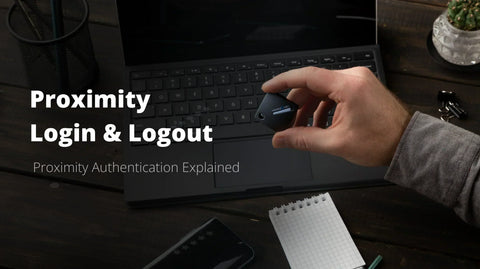
Three radio protocols dominate contactless deployments, and confusing them leads to weak architectures. RFID at 125 kHz transmits a static serial number, readable from up to a meter with cheap cloners, acceptable for parking gates, unacceptable for IT authentication. NFC, standardized under ISO/IEC 14443, operates at 13.56 MHz over roughly 4 cm and supports cryptographic challenge-response, which is why every modern smart card, mobile credential, and FIDO2 NFC key relies on it. BLE extends the range to several meters, enabling proximity unlock and walk-away lock on shared workstations, with secure pairing and signed advertising packets to block relay attacks.
FIDO2, passkeys, WebAuthn, and contactless biometrics (facial, iris, palm vein, liveness)
FIDO2 combines the WebAuthn browser API with the CTAP2 device protocol to deliver phishing-resistant authentication bound to the origin. Passkeys extend this model to mobile and synced credentials. Contactless biometrics — facial recognition, iris, palm vein — verify the user locally on the device, while liveness detection aligned with ISO/IEC 30107-3 blocks deepfake and presentation attacks before the cryptographic assertion is released.
Phishing-Resistant Contactless MFA: The Strategic Core
Why SMS OTP, TOTP, and push notifications no longer cut it
Adversary-in-the-middle kits like EvilProxy and Tycoon 2FA harvest session cookies in real time, neutralizing SMS codes, TOTP apps, and push prompts. CISA explicitly classifies these factors as phishing-vulnerable MFA and recommends migration to FIDO-based authenticators. SMS suffers from SS7 interception and SIM-swap fraud; TOTP shared secrets can be exfiltrated from a phishing page within seconds; push fatigue attacks exploit user behavior rather than cryptography.
How NFC security keys and BLE tokens eliminate credential theft (legacy MFA vs phishing-resistant comparison)
A contactless FIDO2 key cryptographically binds each assertion to the legitimate origin. Tapping an NFC token or pairing a BLE authenticator releases a signed challenge no proxy can replay.
| Method | Phishing-resistant | Shared secret | User friction |
|---|---|---|---|
| SMS OTP | No | Yes | Medium |
| TOTP app | No | Yes | Medium |
| Push notification | No | No | Low |
| NFC / BLE FIDO2 key | Yes | No | Very low |

Integrating Contactless Authentication with Your IAM Stack
Contactless authentication only delivers value when it plugs cleanly into the identity fabric you already operate. The credential issued on an NFC card or BLE token must propagate to your directory, your SSO, and your conditional access engine without custom glue code.
Microsoft Entra ID, Okta, Ping, and on-prem Active Directory
Hideez registers FIDO2 security keys directly against Entra ID, Okta Workforce Identity, Ping Identity, and legacy on-prem Active Directory through a Windows credential provider. User provisioning flows through SCIM or LDAP synchronization, while conditional access policies enforce key-bound sign-in for privileged groups. Lifecycle events (joiner, mover, leaver) revoke the credential in seconds across every connected application.
Supported protocols (SAML, OIDC, WebAuthn) and reference architecture for SSO, VPN, and SaaS
The reference architecture relies on three open protocols: WebAuthn for the user-to-authenticator ceremony, OIDC for SaaS federation, and SAML for legacy SSO consumers. VPN gateways authenticate through RADIUS with a WebAuthn front-end. The result is one contactless credential covering Windows logon, SaaS sign-in, and VPN access, governed by a single policy plane.
Real-World Use Cases for Shared Workstations and Frontline Workers
Shared endpoints are where password fatigue turns into measurable revenue loss. A nurse logging into an EHR 70 times per shift, a machine operator switching between MES terminals, or a cashier rotating on a POS station cannot absorb 15-second password ceremonies. Contactless authentication compresses that friction to under 2 seconds per tap.
Tap-to-login and proximity lock for healthcare EHR, manufacturing MES, and retail POS
In a healthcare environment, a clinician taps an NFC badge on the reader, the workstation unlocks the patient chart, and walking away triggers automatic session lock through BLE proximity. The same Tap-to-login pattern applies to manufacturing MES terminals on the factory floor and POS systems in retail, where shift handovers happen every few minutes. Fast user switching keeps the OS session warm while swapping identities cryptographically.
Hybrid workforce patterns: one credential for laptop, VPN, and door
A single FIDO2 key or mobile credential opens the office door, signs the employee into the laptop, authorizes VPN access, and authenticates SaaS apps.
Compliance, Privacy, and Zero Trust Alignment
Regulators no longer accept passwords as strong authentication. NIS2 mandates phishing-resistant MFA for essential entities, PSD2 SCA requires two independent factors for payment authorization, and HIPAA's Security Rule demands access controls proportionate to PHI exposure. Contactless methods, when properly architected, satisfy these mandates without creating new privacy liabilities.
Mapping methods to GDPR, HIPAA, NIS2, PSD2 SCA, and BIPA with on-device template storage
Biometric modalities raise the bar under GDPR Article 9 and BIPA, which treat fingerprint and facial templates as special-category data requiring explicit consent and minimization. The architectural answer is on-device template storage: the biometric never leaves the secure enclave of the smart card or FIDO2 authenticator, and the server only sees a cryptographic assertion. This pattern aligns with NIST 800-63B AAL3, satisfies PSD2 SCA inherence requirements, and removes the breach surface that centralized biometric databases create.
Contactless authentication as a Zero Trust pillar (NIST SP 800-207)
Zero Trust treats every access request as untrusted until verified. Contactless FIDO2 credentials bind identity to device, enforce continuous verification through walk-away lock, and apply least-privilege through conditional access policies tied to risk signals.

Deployment Playbook: From Pilot to Organization-Wide Rollout
A 90-day phased rollout framework with KPIs, TCO, and ROI
A disciplined rollout protects adoption rates and budget. Days 1-30 cover the pilot: 50 to 100 users on shared workstations, FIDO2 key provisioning, directory binding, and fallback enrollment. Days 31-60 expand to a full department, validating conditional access rules, walk-away lock thresholds, and helpdesk runbooks. Days 61-90 generalize the deployment, decommission password fallbacks, and lock down legacy MFA.
Track four KPIs: authentication time (target under 2 seconds), password reset tickets (typical reduction of 70%), failed login attempts, and enrollment completion rate. On the financial side, a 500-user deployment generally pays back within 14 months through helpdesk savings alone, before counting breach risk reduction.
Common pitfalls: spoofing, deepfakes, BLE relay attacks, and how to counter them
Three attack vectors deserve attention. Facial recognition without ISO/IEC 30107 liveness detection falls to deepfake replay. BLE proximity systems lacking distance-bounding protocols are vulnerable to relay attacks extending the signal across rooms. NFC cloning targets legacy 125 kHz badges that lack cryptographic challenge-response.
Frequently Asked Questions
How does FIDO2 enable phishing-resistant contactless authentication?
FIDO2 binds a cryptographic keypair to the relying party's domain. The private key never leaves the security key or passkey container, and signed challenges cannot be replayed against a fraudulent site. Tapping an NFC-enabled FIDO2 key against a laptop or phone completes WebAuthn authentication without transmitting any reusable secret.
Which contactless method is best for shared workstations and frontline workers?
NFC badge tap combined with proximity-based auto-lock delivers the fastest user switching for nurses, factory operators, and retail staff. A single credential authenticates to the EHR, MES, or POS in under two seconds, then locks the session on walk-away.
How do I ensure GDPR and HIPAA compliance for contactless biometrics?
Store biometric templates on-device, never in a central database. Apply explicit consent under GDPR Article 9, document retention policies, and pair biometric verification with a FIDO2 credential so the template alone grants no access.
Ready to eliminate passwords across your enterprise? Book a consultation with Hideez or explore the Hideez partner program to deploy contactless FIDO2 authentication for your team.